Summary: For my son Moritz, who is seven, I built a sticker album for bird songs with an AI agent. A microphone in our garden in Wilhelmsburg, Lower Austria, identifies the birds, we collect on the go with an app, an e-ink display in the dining room shows the bird of the day and Moritz’s week, and a small cube plays the call. Since late August the project has gathered 88 species and more than 27,000 detections. For businesses the project is of interest because recognition runs on the device, every statement made by the AI is checked a second time and the decisions stayed with me.
What is Papageno?
Moritz wanted to know which birds sing in our garden. A field guide is little help to a child who cannot read yet. So the idea was an album like a football sticker album that the garden fills by itself: listen, identify, collect.
The result has four parts, all working with the same database:
- garden station that listens around the clock
- phone app for collecting on the go
- display in the dining room with the bird of the day and the weekly plan
- cube with a speaker that introduces the bird
We set three rules from day one. Audio recordings go to no third-party cloud, nothing in the album is made up, and everything has to work without reading.
How does a garden listen?
A studio microphone on the roof is connected to a Raspberry Pi. It runs BirdNET, a freely available recognition model from Cornell University and Chemnitz University of Technology. The station filters by location and season. A species only goes into the album at 70 percent confidence or more, rare visitors at 85 percent. A separate step separates the song from wind and noise, so the call is clear enough to listen to.
On the go we collect with the app. The phone listens for 20 seconds and already identifies the bird in the browser. The card is awarded by the station in the end, after a second and more accurate check. If the phone has no connection, the recording goes into a backpack and is uploaded as soon as there is a connection again.
Everything the garden has heard so far is public in the bird diary at papageno.bracharz.com, every species with a photo and the call recorded in our garden. The diary is in German.
How does this work for a child who cannot read?
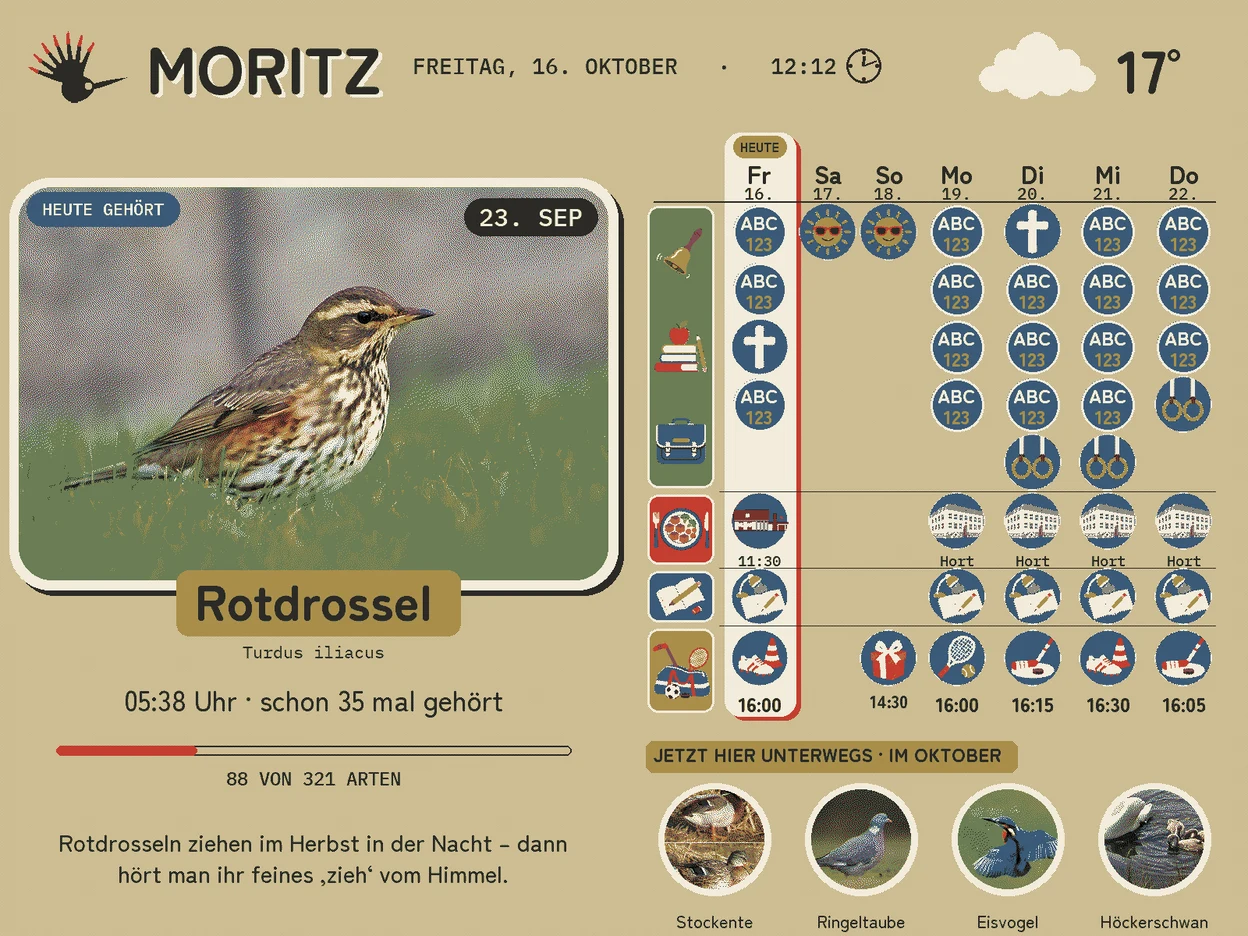
The display is a colour e-ink screen, designed in the style of a risograph print. On the left is the bird of the day as a large photo with one sentence that we read aloud, for example: “Redwings migrate at night in autumn, and that is when you hear their thin ‘tseep’ from the sky.”
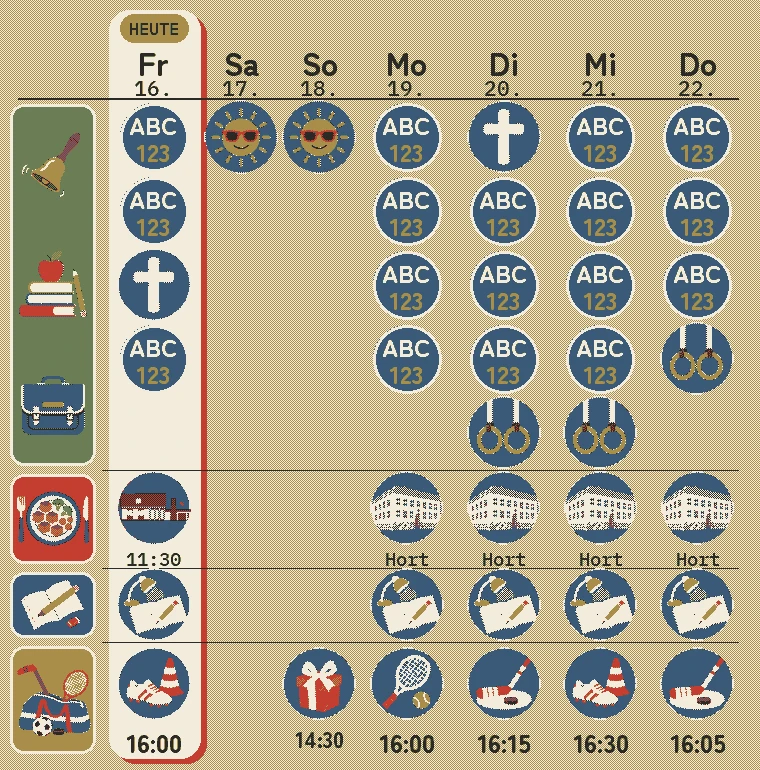
On the right is Moritz’s week as a calendar that always starts with today. Each row has a picture instead of a word (school, lunch, homework, sport). A regular lesson is “ABC 123”, religious education a cross and gym class the rings. Then there is the after-school club, lunch at home, tennis, football, ice hockey, a birthday party with a present and holidays as a sun with sunglasses. Before his own birthday or an ice hockey camp, the display counts down the nights (“6 more sleeps”).
The cube lights up when a new bird has been added. When Moritz presses it, the speaker says the name, plays the call recorded in our garden and tells one fact about the bird.
What did the AI agent do, and what did I do?
Papageno is built with Claude Code, an AI agent by Anthropic. I set the goal, made the decisions and tested everything on the real device. Typical feedback from me was “Moritz doesn’t recognise the blackboard on that card”, “He is vegetarian, so no schnitzel on the picture” or “The house card should show our house”. The agent planned, wrote the code, deployed it to the Raspberry Pis, read the logs, looked for bugs and fixed them, and documented everything.
Since early September this has produced 181 traceable work steps and more than 20,000 lines of code, alongside my day job. Most of my time went into the question of what really helps Moritz. The agent could not take that off my hands.
One example: two phone recordings were stuck in the queue for weeks. The agent found the cause. When picking up work, all waiting recordings were reserved, but only the first one was processed. The bug was fixed and deployed within fifteen minutes.
How reliable is knowledge written by an AI?
For the display, the agent wrote 270 short sentences about our birds. It then checked every sentence against expert sources, namely the species profiles of the Swiss Ornithological Institute in Sempach, BirdLife Austria and the specialist literature. 38 sentences were corrected or removed.
Two of them appear in many books, but according to research they have since been refuted or not confirmed: that kestrels see the trails of mice in ultraviolet light and that magpies recognise themselves in a mirror. Others were exaggerated. For the wren, the first version said it sings “louder than almost any other bird”. What is correct is that it sings astonishingly loud for its size.
An AI writes fluently even when the content is wrong. That is why checking against sources has to be planned in from the start.
What can businesses take from this?
Recognition runs on the Raspberry Pi and in the browser, and no audio recording leaves the house. For many small and medium-sized businesses, this is a simpler path to data sovereignty than yet another cloud contract, and many data protection questions never arise.
The phone suggests a bird, the station decides, and only confirmed results count. For high-risk AI, the EU AI Act requires that it can be effectively overseen by people (source: AI Act, Regulation (EU) 2024/1689, Article 14, as of October 2026). Checking steps like these are best built in right at the start.
Once the display showed a duck at seven in the morning that had called only once, at midnight. We then changed the rule. A bird now needs two calls or one very confident detection.
The app also works without a connection and syncs as soon as it is back online. The same applies to a warehouse or a building site.
What used to be a project for a team over several months was built on the side in a few weeks. That makes it worthwhile to build your own solutions even for very small target groups.
Conclusion
Papageno is a family project, and a seven-year-old is a strict tester. He does not use an interface he does not understand, and he notices straight away when there is a card for a bird that was never there. The AI agent made building fast and affordable. The decisions, the checking and the knowledge of what the user needs stayed with me. I recommend this division of labour to businesses starting out with AI agents too. A second project of my own is described in Your own iPhone app for a niche, the advice around it under AI and the AI Act and in Digitalisation consulting for SMEs.
Frequently asked questions about Papageno
What is BirdNET?
A freely available AI model that identifies more than 6,000 bird species by their voices. It was developed by the K. Lisa Yang Center for Conservation Bioacoustics at Cornell University together with Chemnitz University of Technology.
What hardware is behind it?
Two Raspberry Pis, a USB audio interface with a microphone, a 13.3-inch e-ink display from Pimoroni (Inky Impression), an M5Stack ATOM Echo as the cube and a Chromecast speaker we already had. I will add the costs once the whole project, including the bird feeder camera, is finished.
Can I build Papageno myself?
The parts are freely available, and BirdNET is freely available too, but it may only be used non-commercially. The biggest effort is the software, and in my case the AI agent wrote it.
Can I see which birds sing in the garden?
Yes, in the bird diary at papageno.bracharz.com. It lists every species the station has identified, with a photo, one fact and the call from the garden. The page updates continuously and is in German.
How long did it take?
I set up the hardware from mid-July 2026, and the station has been listening since 27 August. Most of the software was written in September and October, alongside my day job.
Do you need programming skills to build something like this with an AI agent?
You do not have to write code yourself. But you have to know what you want, check the results and make decisions. A basic technical understanding helps to ask the right questions.
Note: This article describes a private project and is not legal advice. Statements on the EU AI Act and the GDPR are simplified.