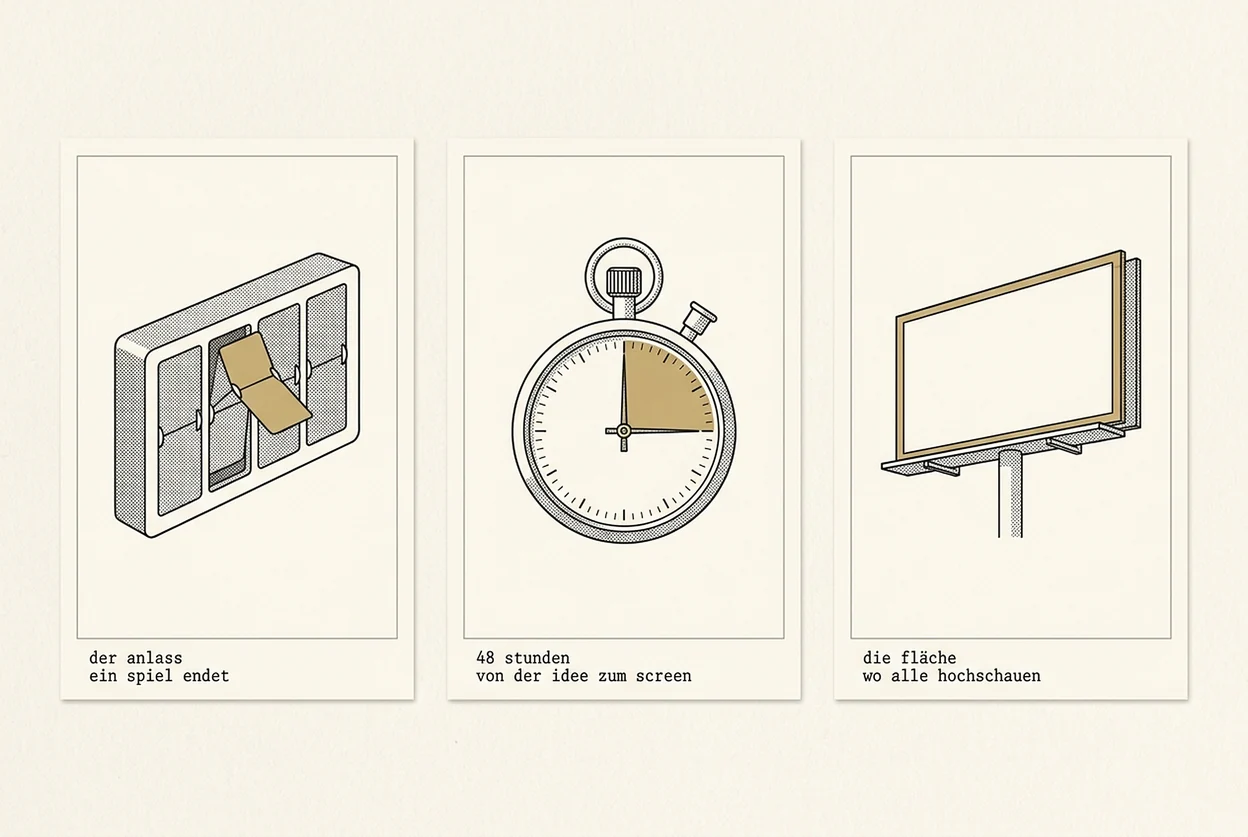
In brief: When Alexander Zverev won the 2026 French Open, Bitpanda spots were running on the largest screens at Hamburg Central Station immediately after the final, produced over the weekend. Real-time DOOH is achievable if four things are settled before the occasion. Here are the lessons from the project.
Why real-time at all?
Occasions beat always-on advertising: a spot that reacts to last night's event earns attention that media budget can hardly buy. But the window is brutally short, anyone who only starts planning after match point loses it to approval loops.
1. Media-owner specs first, not last
Every screen is its own technical beast: the large-format LED billboard “The Whale” at Hamburg Central Station wants 3800 × 900 pixels, airport totems run in portrait at 1080 × 1920, plus video walls in QHD and special formats. Every file must be checked precisely against the media owner's specification for resolution, frame rate, bitrate and audio track, in a real-time window, a rejected file costs you the slot. You obtain the specs before the occasion.
2. Brand compliance under time pressure
The ugliest brand violations happen under time pressure. The solution is groundwork: brand guidelines, original logo animations and colour values are ready to hand, and end cards with mandatory copy (for financial products: the mandatory disclaimers) are approved in advance. In the hot phase, only the occasion-specific material is dropped in, everything else is already built.
3. Image rights decide the night
The best winner's photo is worthless if the licence does not cover DOOH outdoor advertising. Agency images (from Imago or Getty, for instance) carry licences tiered by type of use, editorial is not advertising, online is not out-of-home. Anyone planning real-time clarifies the licensing logic and the budget for it in advance, and keeps a fallback design without third-party material at the ready.
4. The timeline of a weekend
- Before the event: Specs, templates, end cards, approval process and the contact at the media owner are all in place.
- Match point: Material selection and rights clearance, editing starts in parallel.
- Overnight: Production of all format variants, technical checks against every spec.
- Delivery: Early, with a buffer, media owners need lead time for QA and scheduling. On air immediately after the final.
Conclusion
Real-time DOOH is 80% preparation and 20% a fast weekend. If you lock down specs, brand, rights and approvals before the occasion, you can deliver while everyone else is still aligning. The full case study: Bitpanda × Roland Garros.
Frequently asked questions about real-time DOOH
What is real-time DOOH?
Digital-out-of-home advertising that reacts immediately to a current event, for example a spot right after a final, produced and played out overnight.
What must be settled before the occasion?
Four things: the media-owner specs, brand compliance including approvals and end cards, image rights, and a timeline with contacts at the media owner.
What are DOOH specs?
Precise technical requirements per screen for resolution, frame rate, bitrate and audio track, for example 3800 by 900 pixels for a large LED billboard or 1080 by 1920 in portrait. A rejected file costs you the slot in a real-time window.
Why are image rights so critical?
Because licences are tiered by type of use: editorial is not advertising, online is not out-of-home. Without a proper DOOH licence the best winning photo is unusable, so always keep a fallback design without third-party material ready.
How realistic is production over a single weekend?
Real-time DOOH is 80 percent preparation and 20 percent a fast weekend. If you fix specs, brand, rights and approvals in advance, you can deliver while others are still in approval loops.